
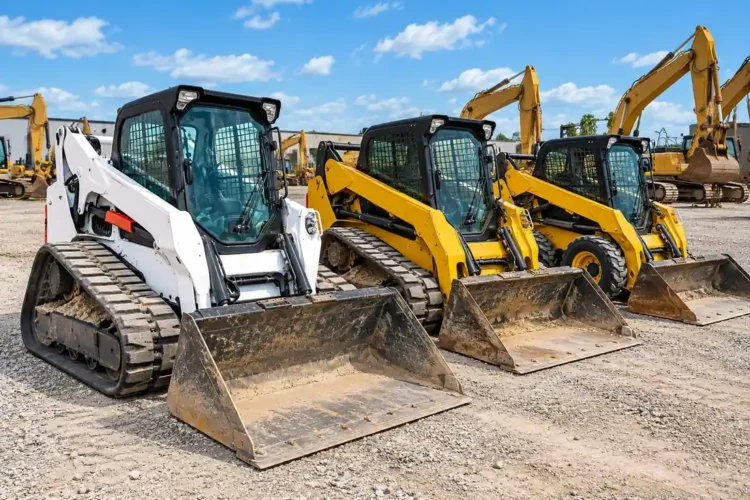
A compact track loader runs on rubber tracks, so it spreads its weight and keeps working on soft, wet or sloped ground. A skid steer runs on wheels, so it is faster on hard surfaces and usually cheaper to rent. Choose by the ground the machine will spend most of its time on.
From the operator’s seat, the two machines feel almost the same. The controls are similar, the attachments often fit both, and either one can grade, dig, lift and clear. The difference sits underneath, and it decides whether the machine spends the day working or stuck.
This guide compares the compact track loader and the skid steer, explains when each one earns its place, and covers what has to be confirmed before the rental is ordered. It also shows how National Dispatching handles that order so the right machine, with the right attachment, arrives when the crew is ready for it.
What is the difference between a compact track loader and a skid steer?
| Compact track loader | Skid steer | |
|---|---|---|
| Undercarriage | Rubber tracks | Rubber tires |
| Best ground | Soft, muddy, sandy or sloped | Hard, paved, compacted or level |
| Ground pressure | Lower, because weight is spread over the tracks | Higher, because weight sits on four tires |
| Surface impact | Gentler on lawns and finished grades | Can rut soft ground, but easy on hard surfaces when driven carefully |
| Speed and travel | Slower over long distances | Faster across a site |
| Typical rental cost | Usually higher | Usually lower |
| Wear items | Tracks and undercarriage | Tires |
Both machines use the same basic layout and many of the same attachments. What changes is traction, flotation and how the machine treats the ground under it.
When are the tracks worth it?
The tracks pay for themselves when the ground is the problem.
- Wet or soft soil, where tires would sink or spin.
- Slopes and uneven ground, where a wider footprint adds stability.
- Sand and loose material, common in landscaping and site prep.
- Finished or sensitive surfaces, such as lawns, where lower ground pressure leaves less damage.
- Seasons with frequent rain, when site conditions change day to day.
In these conditions, a compact track loader keeps working when a wheeled machine would be parked. More working hours often outweigh the higher rental rate.
When do wheels win?
On firm ground, the skid steer is often the smarter choice.
- Paved lots, slabs and roads, where tracks add cost without adding traction.
- Demolition and debris work, where sharp material can damage rubber tracks.
- Jobs with lots of travel, since wheels move faster across a site.
- Tight budgets, since skid steers usually rent for less and tires are cheaper to maintain.
For a deeper look at why the wheeled machine is so common, see why skid steer loaders are the most versatile machines on a job site.
Attachments: confirming the right one ships with the machine
The attachment is often what the job actually needs. The machine is just what carries it. Buckets, pallet forks, augers, grapples, trenchers, brooms and breakers all change what a compact loader can do.
Three things are worth confirming before the order goes in:
- Which attachments are needed, and on which days.
- Whether they fit the machine, since most use a standard quick-attach plate but some need specific hydraulic flow.
- Whether they arrive with the machine or on a separate delivery.
A compact track loader that arrives without its auger is a very expensive way to move a bucket of dirt.
What should be confirmed before the rental is ordered?
- Ground conditions across the work area, now and through the rental period.
- The tasks and attachments, listed by day if the work changes.
- Delivery access, since the machine usually arrives on a trailer that needs room to unload.
- Operator, since compact loaders are usually run by the contractor’s own crew.
- Insurance, either the Rental Equipment Protection plan (REP) or a certificate of insurance (COI).
- Rental length and expected call-off date, so the machine is not left on rent after the work is done.
Getting these right up front is what separates a smooth rental from a week of swaps and extensions.
How a compact loader rental moves from request to return
Compact loaders run on the rental track. The request is taken in and quoted, vendors near the site are compared side by side, and one is selected. A purchase order goes out, the vendor confirms the machine, attachments and delivery window, and the rental agreement and insurance are put on file.
The machine is delivered and confirmed on site, the on-rent clock starts, and any swaps or service calls are handled while it is working. When the job no longer needs it, the call-off is made, pickup is arranged, and the order closes with a reconciled invoice.
If the machine on site turns out to be the wrong one, that same process handles the swap. Moving from a skid steer to a compact track loader after a week of rain is a change order, not a new search.
One desk for every compact machine on the job
Compact equipment often gets ordered in a hurry, by phone, with the attachment details left until later. That is how the wrong machine ends up on soft ground, or the right machine arrives without what it needed to carry.
National Dispatching handles these rentals for approximately 2,450 customer accounts, working with approximately 2,480 vendor accounts across the United States. Machine, attachments, delivery and call-off run through one desk, and if you are also weighing larger machines, our guide on whether a wheel loader is the same as a skid steer explains where loaders fit.
Need a compact loader on site? Send one request to the National Dispatching desk and we will match the machine and attachments to your ground and your schedule.
Frequently Asked Questions
he undercarriage. A compact track loader runs on rubber tracks for better traction and flotation on soft ground, while a skid steer runs on tires and is faster and cheaper on hard surfaces.
Not always. Tracks are better on soft, wet or sloped ground. Wheels are often better on paved surfaces, in demolition and where the machine travels a lot.
Many do, since most use a standard quick-attach plate. Some attachments need specific hydraulic flow, so fit should be confirmed before the rental is ordered.
A skid steer is usually cheaper to rent and to maintain, since tires cost less to replace than tracks.