

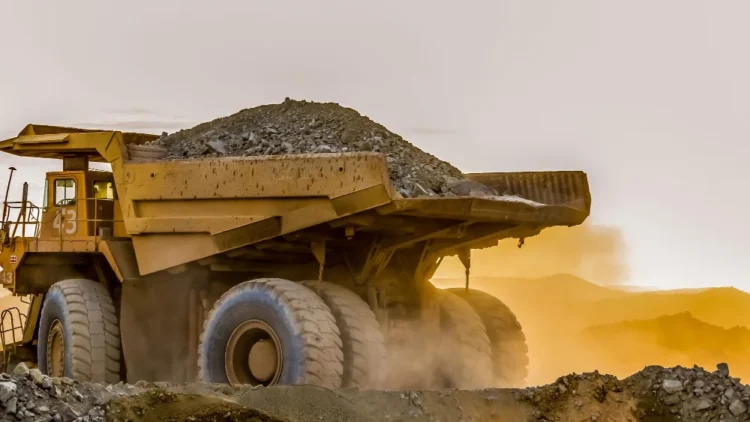
An articulated dump truck bends at a pivot between the cab and the bed, so it handles soft ground, slopes and rough haul roads inside a site.
A rigid or on-road dump truck is faster on paved roads and longer hauls. Choose by where the material travels: on site, or off it.
Two trucks can carry the same dirt and still be the wrong choice for each other’s job. Send a road truck onto a muddy haul road and it sinks. Send an off-road hauler down the highway and it either cannot go or crawls the whole way.The choice between an articulated dump truck and a rigid one comes down to a simple question: where does the material actually travel? This guide covers the difference between the two, when each one makes sense, and why National Dispatching orders them in two different ways.What is the difference between an articulated and a rigid dump truck?
| Articulated dump truck | Rigid or on-road dump truck | |
|---|---|---|
| How it is built | Cab and dump body joined by a pivot, usually with drive to every axle | One fixed frame from cab to bed |
| Where it works best | Soft, muddy, uneven or sloped ground inside a site | Paved and maintained roads |
| Typical haul | Short to medium hauls within the job | Longer hauls between sites, pits and receiving sites |
| Public road use | Generally kept on site | Built for road travel |
| How it is ordered | Rental equipment, run by the contractor’s operator | Trucking service, booked with a driver |
When does an articulated dump truck make sense?
Reach for an articulated hauler when the ground is the problem.- Mass excavation and site grading, where trucks run back and forth on temporary haul roads
- Wet or soft conditions, after rain or on sites with poor soil
- Slopes and uneven terrain, such as road building, embankments and earthworks
- Remote or undeveloped sites, with no paved access to the work area
When is an on-road dump truck the better choice?
When the material has to leave the site, the road truck wins. Rigid dump trucks are built for paved roads, travel faster on them and are licensed to use them. They are the standard choice for:- Hauling excavated material to a receiving site
- Bringing aggregates, base rock or fill from a pit or yard
- Moving material between two job sites
- Any haul where most of the trip is on public roads
Why are the two ordered differently?
This is the part that catches people out. The two trucks may move the same dirt, but they are bought in completely different ways.An articulated dump truck is rental equipment.
It is delivered to the site, stays there for days or weeks, and is usually run by the contractor’s own operator. That puts it on the rental track. The order includes a rental agreement and insurance coverage, either the Rental Equipment Protection plan (REP) or a certificate of insurance (COI). Once on site, the on-rent clock runs until the truck is called off and picked up.An on-road dump truck with a driver is a trucking service.
Nothing is left on site. The truck and driver are booked for a set time or number of loads, billed by the hour or by the load, and the order closes once the work is done. That is the non-rental track.Here is a real trucking order of that kind, with the customer kept anonymous: a 10-wheel dump truck near Dos Palos, California, booked for about 7.6 hours, at a total of $1,615. One request, one truck and driver, one closed invoice.Knowing which track a hauler belongs on changes what the order needs. A rental needs a call-off date. A trucking order needs a billing basis and a start time.How many haul trucks does your excavator need?
Whichever truck you choose, it has to match the machine loading it. If the loading machine is still undecided, start with excavator vs backhoe. If trucks arrive too slowly, the excavator waits. If too many arrive at once, trucks queue with engines running.The right number depends on:- How quickly the excavator fills one truck
- How long a full round trip takes, including dumping
- How much each truck carries
What should a haul truck order include?
- The material being moved and roughly how much
- Where it is loaded and where it goes, on site or off it
- Ground conditions on the haul route
- The loading machine and its expected pace
- Start date and time, plus the on-site contact
- For an articulated dump truck: rental duration and expected call-off date
- For an on-road truck: hourly or load-based billing, and the receiving site
One desk for both kinds of hauling
When off-road haulers and road trucks are booked separately, they rarely move in step. One arrives on a Monday, the other on a Wednesday, and the stockpile in between grows out of control.National Dispatching coordinates both for approximately 2,450 customer accounts, sourcing from a network of approximately 2,480 vendor accounts across the United States. Rentals from the trucks and trailers range and trucking orders run through the same desk, so on-site hauling and off-site hauling stay on one schedule.Moving dirt soon?
Send one request to the National Dispatching desk and we will match the right hauler to the job, on site and off it.FAQ
It is an off-road hauler with a pivot joint between the cab and the dump body. The joint lets it flex and steer over soft, uneven or sloped ground where a rigid truck would struggle.
Articulated dump trucks are designed for off-road work and are generally kept on site. For hauls on public roads, an on-road dump truck is the standard choice.
It depends on where the material travels. Rent an articulated hauler for work across rough ground within a site. Book an on-road dump truck with a driver when the material has to travel on public roads.
On-road dump truck services are usually billed by the hour or by the load. The billing basis should be agreed in writing before the truck is dispatched.