

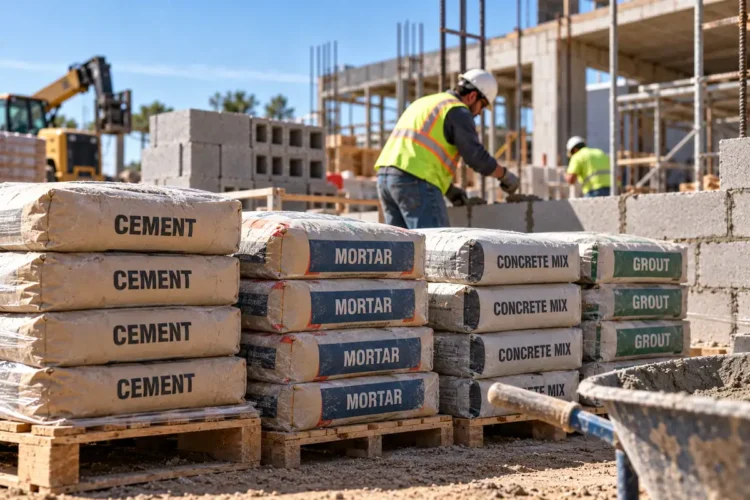
Bagged cement, mortar and grout are small, frequent orders that crews notice only when they run out. Treating them as planned consumables, with the right product for each task, a realistic quantity, dry storage on site and a reorder point, keeps masons and finishers working instead of waiting on a last-minute supply run.
Nobody schedules a meeting about bags of mortar. They are cheap, they are easy to find, and they seem too small to plan. Then a masonry crew runs out at two in the afternoon, someone drives to a supply yard, and half a crew stands around waiting for a pickup truck.
Small orders are where a lot of quiet waste happens on a job. This guide explains the difference between bagged cement, mortar and grout, how to match each to the task, how much to order, how to store it, and how National Dispatching handles these orders as part of a planned supply rather than a series of emergency runs.
Cement, mortar or grout: what is the difference?
The three are related, but they are not interchangeable.
| Product | What it is | Typical uses | Consistency |
|---|---|---|---|
| Bagged cement | Portland cement powder, the binder that holds concrete and mortar together | Mixing your own concrete or mortar, small repairs | A dry powder until mixed with sand, aggregate and water |
| Bagged concrete mix | Cement pre-blended with sand and gravel | Fence posts, small slabs, footings and pads | Stiff once mixed, sets hard and structural |
| Mortar | Cement and lime blended with fine sand | Laying block, brick and stone | Thick and workable, so it holds units in place |
| Grout | Cement-based mix with a higher water content | Filling block cores, voids, gaps around anchors and bases | Fluid enough to flow into tight spaces |
The easiest way to remember it: mortar holds things together, grout fills things in, and bagged cement is the ingredient behind both.
Matching the bag to the task
Picking the wrong product causes problems that show up later. A few common examples:
- Laying block or brick calls for mortar, and the type matters. Mortars are graded by strength, often as Type N, S or M, and the project specification usually says which one to use.
- Filling reinforced block cores calls for grout, not mortar, because it has to flow down and fill the cell completely.
- Setting posts or small pads is usually a job for bagged concrete mix rather than plain bagged cement.
- Specialty work, such as setting equipment bases or anchor bolts, may call for non-shrink grout specified by the engineer.
When a specification exists, the order should name the exact product, not just the category. “Mortar” is not enough information. “Type S masonry mortar” is.
Estimating quantities without overbuying
Bagged products are easy to underorder and just as easy to overorder. Neither is free. Running short stops work. Ordering far too much leaves bags on site that can be ruined by moisture before they are used.
A practical approach:
- Start from the quantities in the plans or the trade’s own takeoff.
- Add a small allowance for waste, spillage and breakage.
- Split large quantities into staged deliveries rather than one drop.
- Set a reorder point, so the next delivery is booked before the last pallet is opened.
That last step is the one most often missed. A reorder point turns bagged cement and mortar from a surprise into a routine.
Keeping bags dry: storage on an active site
Cement reacts with moisture, and that includes humidity in the air. Bags that get wet or sit too long can harden into lumps and become unusable.
Simple rules keep stock in good shape:
- Store pallets off the ground, on dunnage or pallets, never directly on soil or slab.
- Keep them covered and protected from rain, ideally in a container or under cover.
- Use the oldest stock first.
- Do not stack bags so high that the bottom layers are crushed or split.
Smaller, more frequent deliveries help here too. Less stock on site means less time for it to absorb moisture.
Why small orders cost more when they are unplanned
An unplanned bag run looks cheap on the receipt. The real cost is everything around it:
- A crew that slows down or stops while it waits.
- A supervisor or driver pulled off their own work to make the run.
- Retail pricing instead of a negotiated rate.
- No record tying the purchase to the job, which makes cost tracking harder.
Multiply that by a few runs a week across several sites, and small orders become a real line item. They also leave no clean purchase trail, which matters when the job is reconciled.
How bagged materials move from request to closed invoice
Bagged cement, mortar and grout are usually handled as consumable orders, one of six standard order types in managed procurement. They run on the non-rental track: the request is taken in and quoted, suppliers near the site are compared side by side, and a formal purchase order goes out.
The supplier confirms the delivery window, the pallets are dispatched and confirmed on site, and the order moves to invoice and close, where the invoice is reconciled and the supplier’s performance is recorded.
The point is not to make a pallet of mortar complicated. It is to give it the same paper trail and timing as any other order, so it never becomes an emergency. That is the core difference between procurement and dispatching: buying the product is one job, and getting it to the crew on time is another.
One plan for large and small orders
The biggest orders on a job usually get the most attention. The small ones get handled by whoever is free. That gap is where time disappears.
National Dispatching handles both kinds the same way for approximately 2,450 customer accounts, working with approximately 2,480 vendor accounts across the United States. Folding consumables into the same operations management services that cover equipment and bulk materials means bagged cement arrives on a schedule, not on a scramble.
Tired of last-minute supply runs? Send one request to the National Dispatching desk and we will keep your cement, mortar and grout on a planned delivery schedule.
FAQ
Precast concrete is cast and cured in a plant, then delivered as finished pieces. Ready-mix is mixed and delivered fresh, then placed and finished on site within a limited time.
As early as the design allows. Custom precast usually depends on approved drawings and production time, so it should be ordered well before stock items like standard block.
It depends on the weight and the delivery truck. Some trucks have their own lifting equipment. Otherwise the site may need a forklift, telehandler, excavator or crane ready at delivery.
It involves confirming specs and lead times, sequencing deliveries to match installation, planning access and offloading, and checking every piece on arrival.