

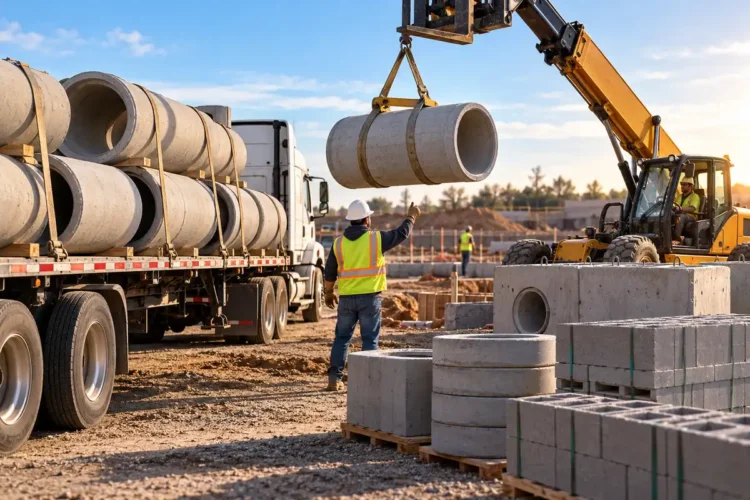
Concrete products procurement means sourcing precast units, block and pipe early enough to cover their lead times, then delivering them in the order the crew will install them. Unlike ready-mix, these products are made ahead, so the risk is not a missed pour window but late, out-of-sequence or unloadable deliveries.
What counts as a concrete product, and how is it different from ready-mix?
Concrete products are made before they reach the site. Ready-mix is made on the way to it.| Product | What it is | Common uses | What drives the order |
|---|---|---|---|
| Concrete block | Standard masonry units, often called CMU | Walls, foundations and retaining structures | Quantity, block size and delivery staging |
| Concrete pipe | Precast pipe sections and fittings | Storm drains, culverts and sewer lines | Diameter, length, joint type and installation sequence |
| Precast units | Engineered pieces cast in a plant | Manholes, vaults, catch basins, barriers and structural elements | Shop drawings, approvals, lead time and lifting plan |
Why do precast items need the longest lead time?
Standard block is often available from stock. Common pipe sizes may be too. Custom precast is a different story. It is usually made to order, which means drawings, approvals, casting and curing all have to happen before anything can ship.That makes lead time the first question in concrete products procurement, not the last. A useful habit is to sort every item on the job into three groups:- Stock items that can be ordered close to the installation date.
- Standard made-to-order items that need a few weeks of notice.
- Custom precast that depends on approved drawings and should be ordered as early as the design allows.
Delivering in install order, not all at once
One large delivery feels efficient. On a tight site, it usually is not. Material stacked in the wrong place gets moved twice, takes up space other trades need, and is more likely to be damaged.A better approach is to match deliveries to the installation sequence:- Pipe delivered in the order it will be laid, starting from the downstream end where the design calls for it.
- Manholes and structures timed to arrive as each run reaches them.
- Block staged close to the walls being built that week, not across the whole site.
Who unloads it? Offloading equipment and site access
Heavy concrete products do not unload themselves. Before a delivery is booked, someone has to answer three questions:- Can the truck reach the drop point? Check gate width, turning room, overhead lines and ground strength.
- What lifts it off? Some suppliers deliver on trucks with their own lifting equipment. Others need the site to provide a forklift, telehandler, excavator or crane.
- Where does it go? Identify a clear, level staging area close to where the product will be installed.
What should every concrete product order include?
Good concrete products procurement starts with a complete order:- Product type, size, quantity and any approved drawing or specification reference.
- Installation sequence and the date each item is needed.
- Delivery address, access notes and staging location.
- Offloading method and who supplies the lifting equipment.
- On-site contact who receives and checks each delivery.
- How damaged or incorrect pieces will be recorded on arrival.
How a concrete product order moves from request to closed invoice
Concrete products run on the non-rental track, because they are delivered once and stay as part of the build. The request is taken in and quoted, suppliers near the site are compared side by side, and one is selected. A formal purchase order goes out, the supplier confirms the lead time and delivery windows, and each load is dispatched and confirmed on site with proof of delivery.The order then moves to invoice and close, where the invoice is checked against what was delivered and the supplier’s performance is recorded.For multi-phase jobs, that same process simply runs once per delivery window, against a single plan.Keeping long lead times and short install windows in step
The hard part of concrete products procurement is holding two timelines together: a supply timeline measured in weeks, and an installation timeline measured in hours. When they drift apart, either the crew waits or the site fills up.National Dispatching manages both sides for approximately 2,450 customer accounts, working with approximately 2,480 vendor accounts across the United States. Its construction materials services cover sourcing, confirmation and delivery, so every piece is planned against the installation schedule rather than chased the week it is needed.Planning a precast, pipe or block installation? Send one request to the National Dispatching desk and we will line up lead times, deliveries and offloading around your crew.
FAQ
Precast concrete is cast and cured in a plant, then delivered as finished pieces. Ready-mix is mixed and delivered fresh, then placed and finished on site within a limited time.
As early as the design allows. Custom precast usually depends on approved drawings and production time, so it should be ordered well before stock items like standard block.
It depends on the weight and the delivery truck. Some trucks have their own lifting equipment. Otherwise the site may need a forklift, telehandler, excavator or crane ready at delivery.
It involves confirming specs and lead times, sequencing deliveries to match installation, planning access and offloading, and checking every piece on arrival.